
The Premise
Four years of school. A degree almost finished. And a growing feeling that something essential was missing.
That tension is where 150 Days begins. Named after the number of days remaining before graduation, the documentary follows me through my final semester at Toronto Metropolitan University as I try to answer a question the program never asked: what is all of this actually for?
What the Project Is
150 Days is a feature-length documentary produced as the capstone project for my Bachelor of Design at TMU. What began as a planned three-episode series evolved during production into a single cohesive 50-minute film. That shift was not a compromise. It was a better decision.
The documentary explores the relationship between art, identity, and the ethics of creative education. It follows me as both subject and filmmaker through my final semester, moving from personal self-discovery through the emotional power of art and arriving at the uncomfortable friction between artistic integrity and business culture.
Faculty from TMU’s fashion and philosophy departments appear as participants throughout, alongside members of the public interviewed at locations across Toronto. There is no conventional script, no predetermined conclusion, and no tidy resolution. The film was designed to ask questions openly and sit with the uncertainty — a deliberate choice rooted in Kierkegaard’s idea of seducing an audience into thinking rather than arguing them toward an answer.
The Production
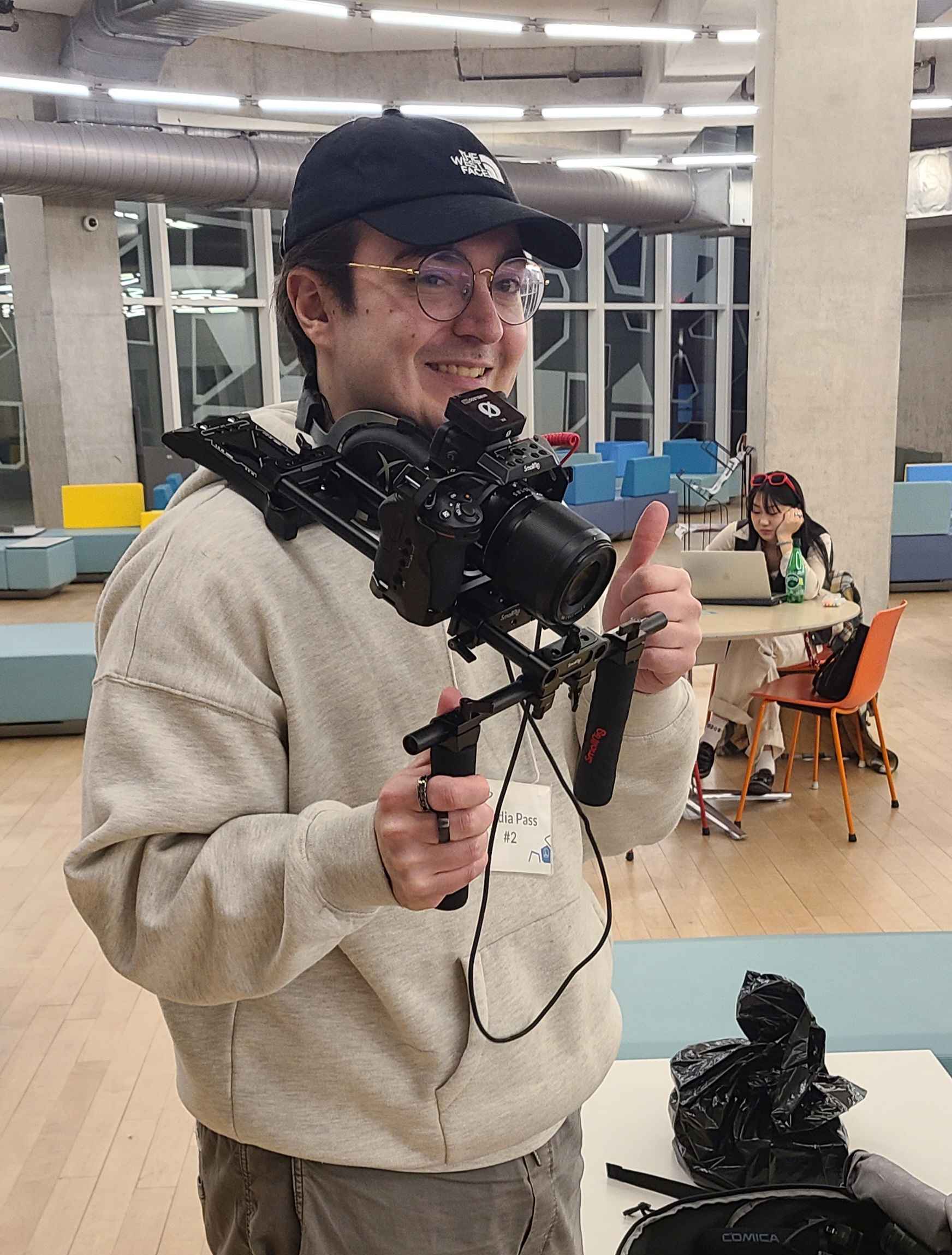
This was a solo-led production built entirely on owned equipment and a small volunteer crew. Every primary role fell to me: director, producer, interviewer, cinematographer, and editor.
The crew consisted of a camera operator, a PA for form signing, a PA for equipment management, a site manager, and a sound consultant. Equipment included a Nikon Z6 mk1 as the primary camera, a Nikon D7100 as a backup for additional angles, a Sigma 50mm prime lens, an 18-35mm wide angle, a RODE wireless mic kit, and a RODE shotgun mic for quieter controlled environments. Post-production was handled entirely in Adobe Premiere Pro and Adobe Audition.
Filming locations spanned Toronto and the GTA. The AGO, the Distillery District, OCAD, Allan Gardens, the Power Plant Contemporary Art gallery, Woodbine Beach, and multiple TMU campus facilities all appear throughout the film. Interviews were conducted over meals and shared activities rather than in formal settings. That was a deliberate choice to break down the distance between student and professor and treat the conversations as genuinely human exchanges rather than academic ones.
The Story
The film opens in the final countdown to the new year. A cut to silence. A morning routine. An inbox full of graduation applications.
From there it moves outward. A philosophy professor covers existentialism, Kierkegaard’s concept of despair, Nietzsche’s will to power, and Sartre’s ideas of freedom and responsibility. Street interviews at the AGO and OCAD explore what art means to people outside academia. A return to Xplanet Games grounds the film in the personal, tracing how hobbies first opened the door to creative thinking for me.
The final act confronts the central tension directly. Marketing tactics learned in the design leadership program are examined against the ethics of artistic integrity. Two professors explore hyperreality, consumerist ideology, and the question of whether art and business can coexist without one compromising the other.
The film does not resolve that question cleanly. It was never supposed to.
What This Project Demonstrates
End-to-end production leadership on a complex, multi-location documentary with a volunteer crew, owned equipment, and no staff budget. Script development, participant coordination, location scouting, shooting, and post-production all managed independently. A planned series adapted into a stronger single feature without losing scope, timeline, or delivery.